Product Description
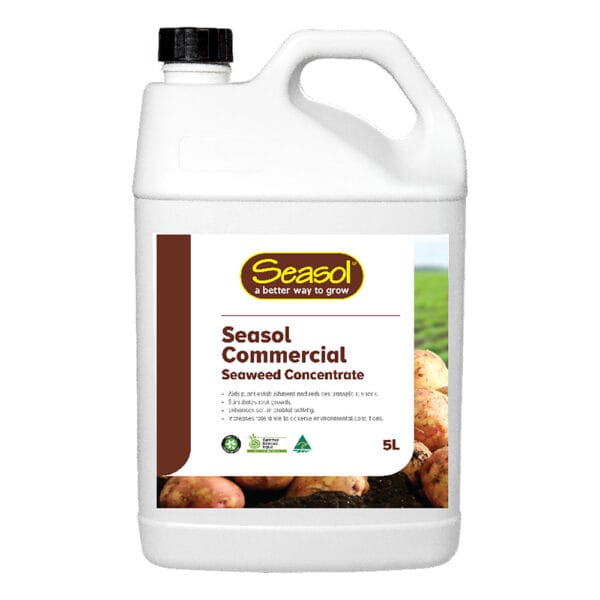
Seasol Commercial is a 20 L pack of liquid seaweed concentrate. Seasol describes it as a plant conditioner and stimulant made from a blend of brown kelps, with natural compounds, trace elements, alginates and carbohydrates. Seasol lists these effects on its own product page: it aids plant establishment and reduces transplant shock, stimulates root growth and flowering, enhances soil microbial activity and increases tolerance to adverse environmental conditions. It is a seaweed product, not a registered pesticide, so these are the maker’s statements, not a label claim about pests or disease.
How to use it. Seasol says never to apply it undiluted, to use it within 24 hours of diluting, and gives these rates: foliar sprays, boom sprayers, under-tree sprinklers and drip or micro-irrigation 5 to 10 L per hectare; overhead sprinklers 1 to 5 L per mm of irrigation; hand sprayers and knapsacks 3 to 5 mL per litre; watering can 20 to 50 mL per 9 L.
Before you buy. The label says keep out of reach of children, not to be taken, may irritate skin and eyes, wash hands after use, and wash edible plants before eating.
Delivery from $17, priced by weight and postcode at checkout.
Application Rates
How to Use Seasol Seaweed Concentrate (Commercial Grade)
Dilution: Mix the concentrate with water before applying it to the foliage and soil around plants.
Application Rates and Frequency:
- Ferns: Mix 20ml per 9L of water. Apply every 2–4 weeks.
- Indoor Plants and Foliar Sprays: Use 20ml per 9L of water every 2–4 weeks.
- Transplanting and Planting: Mix 30ml per 9L of water. Apply at planting and again one week later.
- Vegetables, Herbs, and Annuals: Use 30ml per 9L of water every 2 weeks.
- Established Gardens: Mix 30ml per 9L of water. Apply every 2–4 weeks.
- New Lawns: Use 50ml per 9L of water every 7–10 days during establishment.
- Lawns (Maintenance): Mix 100ml per 9L of water. Apply every 2–4 weeks.
- Large or Stressed Trees: Use 100ml per 9L of water. Apply around the dripline (canopy edge) of the tree monthly.
Important Notes:
Always follow the directions on the label for safe and effective use.
Misuse may be unsafe, ineffective, or against regulations.
Tips for Use
First Aid:
If poisoning happens, call a doctor or the Poisons Information Centre at 131 126 (Australia).
For more details, check the Safety Data Sheet (SDS).
This information is general and not specific advice. Always get expert advice and follow the manufacturer’s instructions before using the product.
Frequently asked questions
What do the three numbers on a fertiliser bag mean?
They are the N-P-K ratio - the percentage by weight of nitrogen (N), phosphorus (P) and potassium (K). Nitrogen drives leaf growth and colour, phosphorus supports roots and establishment, and potassium builds stress and disease tolerance. A blend like 15-4-12 is 15% N, 4% P and 12% K, which suits an established lawn; a higher-phosphorus starter blend suits new turf.
What is the difference between slow-release and fast-release fertiliser?
Fast-release (soluble) fertilisers green the lawn within days but are used up in a few weeks and can burn if over-applied in heat. Slow-release fertilisers feed steadily over 8 to 12 weeks or more, give even growth and are far more forgiving in summer. Many turf managers use slow-release as the base feed and a light liquid feed for a quick colour lift.
How much fertiliser does my lawn need?
Granular turf fertilisers are typically applied at 2.5 to 5 kg per 100 square metres, so a 500 square metre lawn needs roughly 12.5 to 25 kg - about one standard bag per application. Spread it evenly with a spreader and water in straight away. Always follow the rate on the bag, as concentrated blends are applied at lower rates than general-purpose ones.






Reviews
There are no reviews yet.