

Garden Nursery Products
Gold Coast · Est. 1979

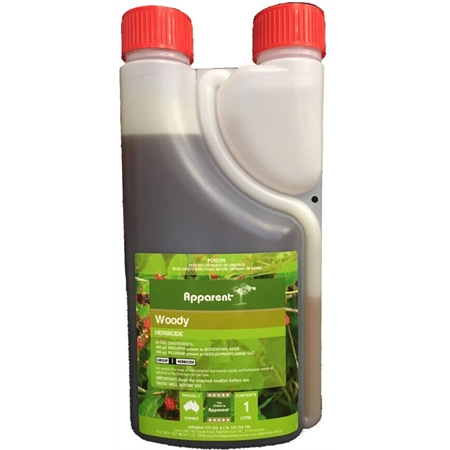
WOODY Herbicide 20L – Powerful Control for Woody Weeds and Perennials

Loading...
Pro-Grade Quality
24hr Dispatch
FARM CHEMICALS · SKU: 038-083C

WOODY Herbicide 20L – Powerful Control for Woody Weeds and Perennials

★★★★★4.7 (55 Google reviews)·Available — In-Store Pickup Only

$550.00 Inc GST

WOODY Herbicide is a 20 L pack of a 300 g/L triclopyr and 100 g/L picloram herbicide. The label lists woody weeds such as blackberry, lantana and gorse in non-crop areas, pastures and rights-of-way. Lawn and home garden are not listed. It damages susceptible plants and picloram can stay in the soil.

Only 1 left in stock

Fast DispatchWithin 24hrs Australia-wide
Quality GuaranteedPro-grade formulations
25 kg43 × 29 × 22 cm
Need Advice?07 5537 4585
Active Ingredient300 g/L Triclopyr, 100 g/L Picloram

Related Products

Loading...

Product Description

WOODY Herbicide is a 20 L pack of a herbicide with 300 g/L triclopyr and 100 g/L picloram (Group 4, APVMA 64014). The label lists woody and some herbaceous weeds such as blackberry, lantana, gorse, camphor laurel, brooms, wattles and eucalypt species in agricultural non-crop areas, commercial and industrial areas, forests, pastures and rights-of-way, plus some fallow situations. Lawn or turf and home garden are not listed as uses.

It will damage plants you want to keep. The label lists susceptible plants including flowers, fruit, ornamentals, shade trees, pines, potatoes, tomatoes, vegetables, vines and legumes, and says it damages them during both growing and dormant periods. Grasses are normally unaffected. Picloram can stay in the soil for extended periods. Do not apply close to the roots of desirable plants, where rain may wash treated soil onto areas growing or to be planted with them, and do not move treated soil to places where desirable plants will grow.

When not to spray. Do not apply to stressed weeds, if rain is likely within one hour or foliage is wet from rain or dew, or under conditions that may cause drift onto susceptible plants, crops, pastures, waterways or native vegetation. Do not burn off, cut or clear blackberry or other woody weeds for at least six months after spraying.

Withholding period. Not required when used as directed.

How to use it. Rates depend on the weed, for example blackberry 350 or 500 mL per 100 L of water and gorse 250 to 500 mL per 100 L depending on height and season. See the Application Rates tab, our herbicide mixing guide and the full label before mixing.

Before you buy. The label says it is very toxic to aquatic life: do not contaminate streams, rivers or waterways with the chemical or used containers. When preparing the spray it asks for cotton overalls buttoned to the neck and wrists, a washable hat, elbow-length chemical resistant gloves and a face shield or goggles. If poisoning occurs, contact a doctor or the Poisons Information Centre on 13 11 26.

Delivery from $17, priced by weight and postcode at checkout.
Additional information

Weight25 kg
Dimensions43 × 29 × 22 cm
Size

20L

Safety Data Sheets (SDS)

Application Rates

APPLICATION RATE

Use 350-500 mL of Woody Herbicide per 100 liters of water for most weeds.
For better results, mix with compatible herbicides like Metsulfuron Methyl, 2,4-D Amine 625, Lantana DP 600, or Glyphosate. Add adjuvants like Wetter 1000 or Polyether Modified Polysiloxane Penetrants (Pulse, Probe, Eurochem, or Saturate). Always check the product label for exact rates and instructions.


EQUIPMENT NEEDED
Choose equipment based on the size of the infestation:

Large jobs (e.g., dense blackberry growth): Use a motorized pump with a handgun. Consider hiring equipment or a professional spray applicator.
Smaller jobs: A knapsack or hand pump sprayer is sufficient if you can achieve good coverage (to the point of runoff).


Additional tools and safety gear:

Measuring jug
Cotton overalls or long-sleeved shirt and long pants
Washable hat
Elbow-length PVC gloves
Safety glasses or face shield
Use sprayers dedicated to herbicides to prevent cross-contamination.


MIXING INSTRUCTIONS

Use clean water from a town supply or rainwater tank if possible. Avoid hard or alkaline water as it reduces effectiveness.
Half-fill the spray tank with water, add Woody Herbicide, then fill with water to the desired level.
If the label recommends, mix in any spray oils, penetrants, or wetting agents once the tank is full.


Storage and Use

Agitate the solution continuously while spraying.
If spraying is delayed, store the mixture for up to 7 days, agitating daily and thoroughly before reuse.


IMPORTANT
Always read the product label for detailed instructions, safety precautions, and first aid guidance before use.

Tips for use

Application Timing for Best Results:

Control Weeds Early: Smaller weeds are easier to eliminate than larger ones.
Ideal Conditions: Apply Woody Herbicide when weeds are actively growing and not stressed by dry weather, heat, insect damage, or disease. Healthy, actively growing weeds absorb the herbicide, allowing it to travel through the plant to the roots for maximum effectiveness.

Avoid Rain or Wet Leaves: Ensure the herbicide dries on the weeds before rain (usually within one hour). Don’t spray on wet leaves or if rain is expected soon.
Leave Weeds Undisturbed: After spraying, don’t disturb weeds (e.g., slashing, burning, or mulching) until the herbicide has fully worked. For best results on woody weeds like blackberries, avoid disturbance for at least six months.


Application Methods:
Spot Spray: Spray all leaves and stems until wet, just before the spray starts to drip. Use a sweeping motion, similar to painting a wall, and follow up with a direct stream to treat stems and canes.

High-Volume Spraying: For effective coverage, apply a large amount of spray to thoroughly coat all parts of the weed, including the inner and outer foliage. Use equipment such as a hand pump, knapsack sprayer, or motorized sprayer with a handgun.

Full Coverage: Ensure sufficient chemical reaches the foliage to kill the entire weed, including its roots. For larger weeds like mature blackberries, make sure the spray penetrates to inner canes.

Volume Guide: For blackberries 1–2 meters tall, use 3000–4000 liters of spray per hectare. For smaller weeds like ragwort, use 500–1000 liters per hectare.


Important Notes:
Read the Label: Always follow the product label for detailed instructions and specific usage conditions.

First Aid: If poisoning occurs, contact a doctor or Poisons Information Centre (Australia: 131 126). Refer to the Safety Data Sheet (SDS) for additional safety information.

Further Information: Check the “Directions for Use” section on the product label before applying.

Active Ingredients

300 g/L TRICLOPYR present as BUTOXYETHYL ESTER 100 g/L PICLORAM present as HEXYLOXYPROPYLAMINE SALT

Reviews

There are no reviews yet.

Be the first to review “WOODY Herbicide 20L – Powerful Control for Woody Weeds and Perennials”

Your email address will not be published. Required fields are marked *

Frequently asked questions

What is the difference between a selective and a non-selective herbicide?

A selective herbicide kills target weeds while leaving desirable plants unharmed - for example, a lawn-safe product that removes bindii and clover from buffalo or couch without damaging the turf. A non-selective herbicide such as glyphosate kills almost any green plant it contacts, so it is used for driveways, fence lines, garden-bed prep and total vegetation control, never on lawns.

What is a pre-emergent herbicide and when do I apply it?

A pre-emergent creates a barrier in the top layer of soil that stops weed seeds from establishing as they germinate. It does not control weeds that are already growing. Apply it before the target weed germinates - late summer to early autumn for winter grass, and early spring for summer grasses like crabgrass and crowsfoot - then water it in.

Will herbicide damage my lawn?

Only if you use the wrong type. Non-selective herbicides (glyphosate) will kill or badly damage turf. Selective lawn herbicides are formulated to be safe on common Australian turf at label rates, but tolerance varies by grass - buffalo is the most sensitive - so always check the label lists your turf type before spraying.

EXCLUSIVE SAVINGS

Get 5% Off WHEN YOU JOIN OUR NEWSLETTER

Get deals sent straight to your inbox