


By the Garden Nursery Products team, Gold Coast, trading since 1979. Reviewed 11 November 2026.
Walk into any garden store and there are dozens of bags, bottles and numbers. Some say “organic”, some say “slow release”, some say “for couch”. They are not all the same thing, and the pack in your hand tells you more than the front label does.
This guide shows how to choose a lawn fertiliser by reading the pack, matching it to your grass and the season, and following the directions. It does not rank products. If you are unsure, call the team at Garden Nursery Products on 07 5537 4585 and we will help you read the pack. You can also use our Start Here guide finder to pick your grass type and problem.
In this guide
- Quick start
- What the N-P-K numbers mean
- Match the fertiliser to your grass
- Lawn blends, organic fertilisers and single nutrients
- Granular or liquid?
- When to fertilise
- Common mistakes
- A simple plan
- FAQ
Quick start: how to choose a lawn fertiliser
- Know your grass. Look at the leaf blade. Our couch grass guide helps if you are not sure.
- Read the analysis on the pack. The three numbers show the nitrogen (N), phosphorus (P) and potassium (K) in the product.
- Check what the pack says it is for. Look for your grass type or “lawn” on the pack itself.
- Feed when the lawn is actively growing. For warm-season lawns such as buffalo, couch, zoysia and kikuyu that is usually spring to early autumn.
- Follow the rate and directions on the pack, and do not spread on hot days.
What the N-P-K numbers mean
Every fertiliser pack shows an analysis. The numbers are nitrogen (N), phosphorus (P) and potassium (K). Some packs add sulfur (S), iron or other nutrients.
Bunnings’ lawn advice notes that grass that looks yellow may lack nitrogen, and that potassium helps turf stand up to extreme weather. Use that as a starting point, then follow your pack’s directions for how much to use.
Real examples from packs we sell:
- CK 88 (Incitec Pivot): NPKS 15-4-12 plus sulfur, a high-nitrogen granular blend.
- Organic Link Lawn & Turf (the pack says Plant of Health Lawn and Turf): N 11.9, P 2, K 8 as printed on the pack.
- ECO 88 (Qld Organics): N 10, P 3, K 8, S 11.6, iron 1.0.
- Urea: 46-0-0, which means nitrogen only.

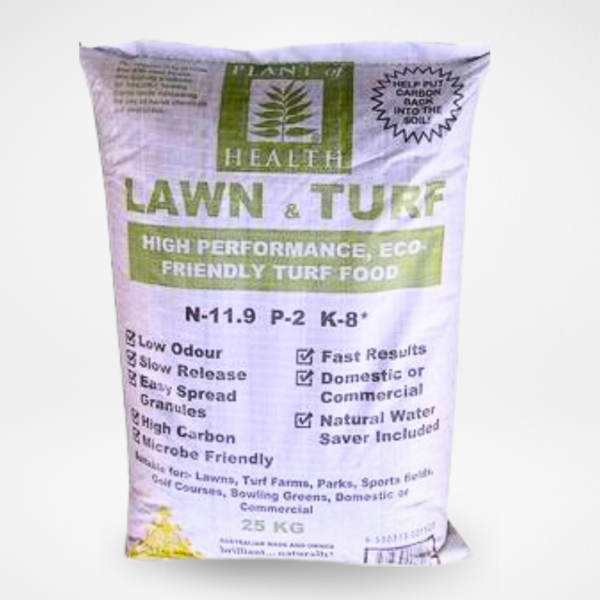

Pack analysis at a glance
| Product | Analysis on the pack | What our product page says | Pack |
|---|---|---|---|
| CK 88 (Incitec Pivot) | N 15, P 4, K 12 plus sulfur | High-nitrogen granular fertiliser for couch, kikuyu and other warm-season lawns | 25 kg |
| Organic Link Lawn & Turf (pack: Plant of Health) | N 11.9, P 2, K 8 | Blended granular lawn fertiliser; lists couch, shade, buffalo and broadleaf lawns, turf fields and parks | 25 kg |
| ECO 88 (Qld Organics) | N 10, P 3, K 8, S 11.6, iron 1.0 | Professional lawn and garden fertiliser with sulfate of potash | 16 kg |
| Urea (Incitec Pivot) | 46-0-0 (nitrogen only) | High-nitrogen, single-nutrient fertiliser | 25 kg |
Analysis as printed on each pack or listed on our product page, checked 11 November 2026. Rates and directions are on the pack.
Match the fertiliser to your grass
Different lawns have different needs, and advice varies. Bunnings says kikuyu responds well to nitrogen, and suggests limiting nitrogen on couch, while our CK 88 page lists that blend for couch, kikuyu and other warm-season lawns. That is one reason to follow the directions on your own pack instead of copying a neighbour or a website, including ours.
Feeding at a glance by grass type
| Grass | Type | When to feed (Bunnings) | Nitrogen note (Bunnings) |
|---|---|---|---|
| Buffalo | Warm-season | Spring to early autumn | No specific tip; follow your pack |
| Couch | Warm-season | Spring to early autumn | Limit nitrogen |
| Kikuyu | Warm-season | Spring to early autumn | Responds well to nitrogen |
| Zoysia | Warm-season | Spring to early autumn | No specific tip; follow your pack |
| Fescue, rye, Kentucky bluegrass | Cool-season | Autumn and spring | No specific tip; follow your pack |
Source: Bunnings, “How to use lawn fertiliser”, read 11 November 2026. Packs differ, so follow the directions on yours.
What we can say from the packs and our product pages:
- Our Organic Link Lawn & Turf page says the pack lists couch, shade, buffalo and broadleaf lawns, turf fields and parks.
- Our CK 88 page lists couch, kikuyu and other warm-season lawns, at 3 kg per 100 m² three times a year.
- For other grass types or a mixed lawn, ask us before you buy.
Lawn blends, organic fertilisers and single nutrients
- Lawn blends (for example CK 88, Organic Link Lawn & Turf and ECO 88) give you a printed analysis of several nutrients in one bag.
- Organic lawn and garden fertilisers such as Turfmaster Fines (blood and bone, slow release and naturally composted per the pack) and Organic Xtra (composted manure, fish meal, natural minerals, blood and bone, seaweed and added sulfate of potash; in-store pickup only) list what goes into them on the pack.
- Single-nutrient products like urea supply one nutrient, nitrogen. They are not a complete feed on their own. Our urea 46-0-0 guide covers it in more detail.
- Want to know what “slow release” really means? Read our guide to slow-release fertilisers.
- For the bigger picture, read the role of fertilisers in a healthy lawn.
Organic or not, none of these is “better” for every lawn. Choose by the analysis, the directions and the job you want it to do.
Bunnings notes that chemical fertilisers suit quick growth, while organic fertilisers break down a bit more slowly. Our guide to organic vs synthetic fertilisers goes into more detail.
Granular or liquid?
Bunnings says liquid fertilisers are quick to absorb but need more regular application, while pellets and granules break down slowly over time and suit larger areas and a more hands-off approach. For liquid feeds, it suggests watering the lawn before you apply. Our guide to liquid vs granular fertilisers compares the two.
When to fertilise
Bunnings’ advice for warm-season grasses (buffalo, couch, zoysia and kikuyu) is to feed during their active growing season, usually spring to early autumn. For cool-season grasses such as fescue, rye or Kentucky bluegrass, it is autumn and spring.
As one example, our CK 88 page recommends three applications a year, in March, September and December. Other products have different directions, so check yours.
Common mistakes
- Guessing the grass type.
- Skipping the pack directions and using more than the rate printed on it.
- Feeding on hot days.
- Buying by front-of-pack words like “premium” or “boost” instead of the analysis.
- Treating a nitrogen-only product as a complete feed.
A simple plan
- Identify your grass and measure your lawn in m².
- Pick a product whose pack lists your type of lawn, and read its analysis.
- Work out how much you need from the pack rate (for example, 3 kg per 100 m² for CK 88 per its page).
- Feed at the start of the active growing season and again as the directions say.
- Water in as the pack directs.
Frequently asked questions
What do the three numbers on a fertiliser mean?
They show the nitrogen (N), phosphorus (P) and potassium (K) in the product. Some packs also list sulfur, iron or other nutrients.
When should I fertilise a warm-season lawn?
Bunnings says during the active growing season, usually spring to early autumn. Always follow the timing on your pack.
Is organic fertiliser better than other fertiliser?
Neither is better in every case. Compare the analysis and directions on each pack and choose the one that suits your lawn.
How much fertiliser do I put on per square metre?
Use the rate printed on your pack. For example, our CK 88 page says 3 kg per 100 m², which is 30 g per m².
Can I use urea on my lawn?
Urea is 46% nitrogen (46-0-0) and contains no phosphorus or potassium. Use it only at the rate on its pack.
How do I tell what grass I have?
Look at the leaf blade and the way it spreads. See our couch grass guide or call us.
GNP products for lawn feeding
That is how to choose a lawn fertiliser: read the analysis, match it to your grass and the season, and follow the directions on the pack. Browse our fertilisers at Garden Nursery Products, based in Arundel on the Gold Coast. Delivery from $17, priced by weight and postcode at checkout, or collect from our Arundel store at no charge. Not sure what to buy? Call us on 07 5537 4585 or visit our contact page.
Related reading: the importance of soil pH and how to adjust it and common fertiliser mistakes and how to avoid them.