

Garden Nursery Products
Gold Coast · Est. 1979

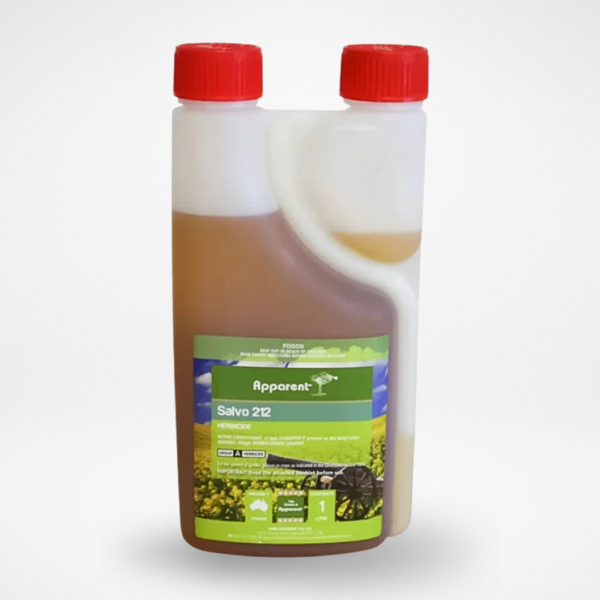
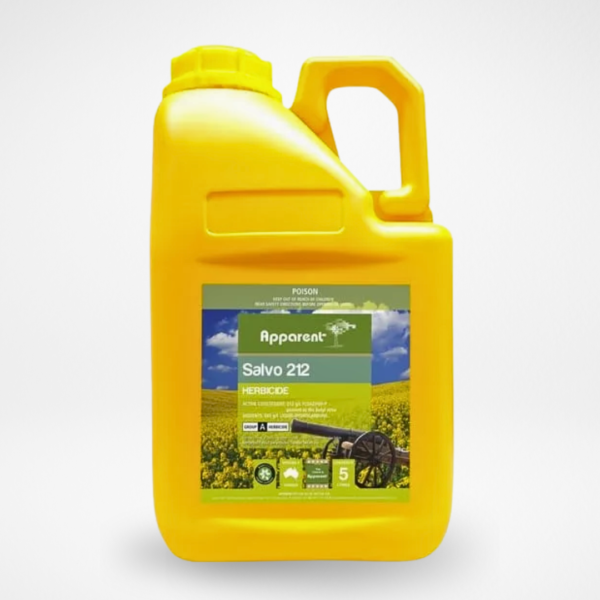
SALVO 212 Herbicide 20L

Loading...
Pro-Grade Quality
24hr Dispatch
FARM CHEMICALS · SKU: 038-079A

SALVO 212 Herbicide 20L

★★★★★4.7 (55 Google reviews)·Available — In-Store Pickup Only

$814.00 Inc GST

SALVO 212 Herbicide is a 20 L pack of a 212 g/L fluazifop-P grass herbicide. The label lists grasses in named crops and in ornamental shrubs and trees; lawn is not listed. It does not control broadleaf weeds, winter grass or nutsedge.

Out of stock

Fast DispatchWithin 24hrs Australia-wide
Quality GuaranteedPro-grade formulations
25 kg44 × 29 × 22 cm
Need Advice?07 5537 4585
Active Ingredient212 g/L Fluazifop-P

Related Products

Loading...

Product Description

SALVO 212 Herbicide is a 20 L pack of a 212 g/L fluazifop-P grass herbicide (Group 1, APVMA 67039). The label lists annual and perennial grasses in named crops such as legumes, canola, soybeans, vegetables, potatoes, fruit and tree crops, and in potted and open grown ornamental shrubs and trees in nurseries, parks and gardens. Lawn or turf is not listed as a use.

What it does not control. The label says it does not control winter grass (Poa annua), silver grass, nutsedge, blady grass or broadleaf weeds. Do not treat weeds that are not actively growing, under stress, in high temperature and low humidity, or at the flowering stage, and do not let annual grasses reach late tillering before spraying.

Where not to use it. Do not apply over the top of Protea, Mesembryanthemum, Browallia or Verbena; apply only as a directed spray. Do not apply under weather conditions or with equipment that may cause drift onto nearby susceptible plants, crops or pastures. Do not tank mix with other pesticides without checking with the supplier.

Harvest and grazing. Withholding periods run from none (stone fruit, pome fruit, citrus) to 17 weeks (lupins, canola, soybeans), and grazing periods from 21 days to 14 weeks. Check the label for your crop.

How to use it. Rates depend on the weed and growth stage, for example in ornamentals 750 mL or 1 L per hectare for seedlings and 2 or 4 L for established plants, or 12.5 to 25 mL per 10 L for spot spraying seedlings. The label says it is rainfast within one hour. Read the full label before mixing.

Before you buy. The label says it is toxic to aquatic life, so avoid release to the environment and collect spillage. It asks for elbow-length PVC gloves and a face shield. If poisoning occurs, contact a doctor or the Poisons Information Centre on 13 11 26.

Delivery from $17, priced by weight and postcode at checkout.

Additional information

Weight25 kg
Dimensions44 × 29 × 22 cm
Size

20L

Safety Data Sheets (SDS)

Application Rates

The application rate for Salvo 212 herbicide typically ranges from 250ml to 500ml per hectare depending on the weed density and growth stage, with higher rates used for denser weed populations or less ideal conditions; always consult the product label for specific instructions based on your crop and weed type.

Key points about Salvo 212 application:

Weed stage: Apply when weeds are actively growing at the 2-5 leaf stage, before tillering commences.

Water volume: Ensure a minimum water volume of 50 liters per hectare is used.
Higher rates: Use the higher rate (500ml/ha) for dense weed populations or less favorable conditions.

Tips for use

When using Salvo 212 herbicide, key tips include: applying to actively growing young grass weeds before they reach the tillering stage, using a higher water volume for dense infestations, spot spraying only where needed, and always following label instructions regarding application rates and safety precautions; it is most effective on grasses like couch grass, kikuyu, and barley grass, and should not be applied to stressed or flowering weeds.


Important points to remember:

Target young weeds:
For optimal control, spray Salvo 212 on actively growing grass weeds when they are at the 2-5 leaf stage, before they start tillering.

Spot spray:
Use spot spraying techniques to target only the unwanted grasses, minimizing impact on desired plants.

Water volume:
Apply a sufficient amount of water to ensure good coverage, especially when dealing with dense weed populations.

Weather conditions:
Avoid applying Salvo 212 in extreme weather conditions like high winds or heavy rain.

Safety gear:
Always wear appropriate personal protective equipment (PPE) like gloves, long sleeves, and eye protection when handling herbicides.

Read the label:
Carefully read and follow all instructions on the product label regarding application rates, mixing ratios, and crop compatibility.

Common weeds controlled by Salvo 212:
Annual ryegrass, Barley grass, Brome grasses, Couch grass, Kikuyu grass, and Wild oats.

Active Ingredients

212g/L FLUAZIFOP-P present as the butyl ester SOLVENT: 703g/L HYDROCARBON SOLVENT

Reviews

There are no reviews yet.

Be the first to review “SALVO 212 Herbicide 20L”

Your email address will not be published. Required fields are marked *

Frequently asked questions

What is the difference between a selective and a non-selective herbicide?

A selective herbicide kills target weeds while leaving desirable plants unharmed - for example, a lawn-safe product that removes bindii and clover from buffalo or couch without damaging the turf. A non-selective herbicide such as glyphosate kills almost any green plant it contacts, so it is used for driveways, fence lines, garden-bed prep and total vegetation control, never on lawns.

What is a pre-emergent herbicide and when do I apply it?

A pre-emergent creates a barrier in the top layer of soil that stops weed seeds from establishing as they germinate. It does not control weeds that are already growing. Apply it before the target weed germinates - late summer to early autumn for winter grass, and early spring for summer grasses like crabgrass and crowsfoot - then water it in.

Will herbicide damage my lawn?

Only if you use the wrong type. Non-selective herbicides (glyphosate) will kill or badly damage turf. Selective lawn herbicides are formulated to be safe on common Australian turf at label rates, but tolerance varies by grass - buffalo is the most sensitive - so always check the label lists your turf type before spraying.

EXCLUSIVE SAVINGS

Get 5% Off WHEN YOU JOIN OUR NEWSLETTER

Get deals sent straight to your inbox