

Garden Nursery Products
Gold Coast · Est. 1979

Amine 625 Herbicide 20L

Loading...
Pro-Grade Quality
24hr Dispatch
FARM CHEMICALS · SKU: 038-009

Amine 625 Herbicide 20L

★★★★★4.7 (55 Google reviews)·Available — In-Store Pickup Only

$261.85 Inc GST

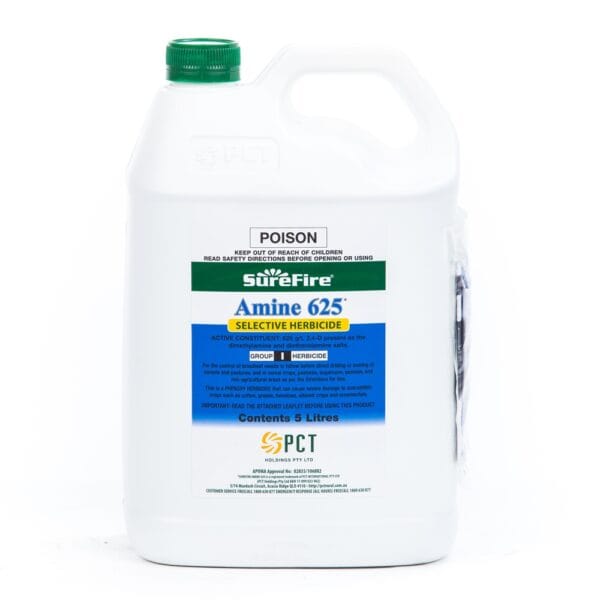
AMINE 625 Herbicide is a 20 L pack of a 625 g/L 2,4-D phenoxy herbicide. The label lists broadleaf weeds in cereals, pastures, non-agricultural areas, and lawns and playing fields in some states. It can cause severe damage to ornamentals, vegetables, vines and native plants through drift.

Only 2 left in stock

Fast DispatchWithin 24hrs Australia-wide
Quality GuaranteedPro-grade formulations
24.5 kg39 × 29 × 29 cm
Need Advice?07 5537 4585
Active Ingredient625 g/L 2,4-D present as the dimethylamine and diethanolamine salts.

Related Products

Loading...

Product Description

AMINE 625 Herbicide is a 20 L pack of a 625 g/L 2,4-D herbicide (as the dimethylamine and diethanolamine salts, Group I; Surefire Amine 625). The label lists broadleaf weeds in cereal crops, pastures, sugar cane, peanuts, fallow and non-agricultural areas, and lawns and playing fields in some states (Qld, NSW and ACT: 1.5 to 3.0 mL per litre of water; WA: 40 mL per 10 to 15 L of water per 100 m²). It is a phenoxy herbicide, so read the warnings below before you buy.

It will damage plants you want to keep. The label says it can cause severe damage to native vegetation and susceptible crops such as cotton, grapes, tomatoes, oilseed crops and ornamentals. Do not apply under weather conditions or with equipment that may cause drift onto nearby susceptible plants, such as cotton, tobacco, vines, fruit trees, vegetables, ornamentals, legume crops and pasture. The label sets wind speed and droplet size limits, and says not to apply if hazardous surface temperature inversions are present.

Grazing and cleaning. Do not graze or cut pasture and cereal crops for stock food for 7 days after application. Equipment used for this product should not be used on sensitive plants unless it has been washed out with hot soapy water or a 1% ammonia solution, then rinsed several times with clean water.

Waterways and bees. Very toxic to aquatic life: do not contaminate wetlands or watercourses with the product or used containers. The label calls it low hazard to bees.

How to use it. Rates depend on the situation, weed and state. See the Application Rates tab, our herbicide mixing guide and the full label before mixing.

Before you buy. When opening the container and preparing the spray, and when applying by open cab boomspray or hand-held equipment, the label asks for chemical resistant waterproof clothing, a washable hat, elbow-length chemical resistant gloves, impervious footwear and a full facepiece respirator with an organic vapour cartridge. If poisoning occurs, contact a doctor or the Poisons Information Centre on 13 11 26.

Delivery from $17, priced by weight and postcode at checkout.

Additional information

Weight24.5 kg
Dimensions39 × 29 × 29 cm
Size

20L

Safety Data Sheets (SDS)

Application Rates

General Usage:

Lawn & Playing Fields: Mix 15mL–30mL per 10L of water, or use 1.6L–3.2L per hectare. (WA: Use 40mL per 10–15L of water per 100sqm).
Pastures (Spray Graze Techniques): Use 280mL–3.2L per hectare.
Conservation Tillage (Direct Drilling, Surface Sowing, or Fallow Maintenance): Use 560mL–1.6L per hectare.


Water Application Rates:

Boom Spraying: Apply 30–120L of water per hectare.
Aerial Spraying: Apply 10–90L of water per hectare.


Turf Application:

Ensure the foliage is thoroughly wet.
Avoid mowing for 1 week before and 1 week after application.
Do not use on buffalo grass.


Converting per Ha Rate to Spot Spraying:
High volume spraying – Add 1/10th of rate on Weed Table to 150 litres of water. Each 150 litres of mix will cover 1000m2 (1/10th ha) eg. if rate in Weed Table is 1.4L, use 140 mL/150L water.
Knapsack Application – Add 1/100th of rate on Weed Table to 10 litres of water. Each 10 litres of mix will cover 100m2 (1/100th ha) eg. if rate in Weed Table is 1.4L, use 14 mL/10L water


Important:

Always read the full Directions for Use on the label before application.
Follow all precautionary statements and safety instructions.
Using the product incorrectly may be unsafe and ineffective.

For Surefire Amine 625 Selective Herbicide Directions for Use, download this guide.

Tips for use

Crop and Plant Protection:

Avoid spraying in high winds.
Don’t spray cereal crops if Lucerne is present.
Only spray crops and weeds during the recommended stages to avoid damage, yield loss, or poor weed control.


Drift Warning:

Do not spray in conditions that may cause drift onto nearby crops, plants, or pastures.
Sensitive crops include cotton, tobacco, tomatoes, flowers, vegetables, vines, fruit trees, legumes, oilseeds, and certain trees.
Only spray when wind speeds are between 3–15 km/h and use coarse to very coarse droplets.


Livestock Safety:

This product is safe for bees and can be used as directed at any time.


Storage and Disposal:

Keep in the original container, stored in a cool, ventilated place.
Avoid prolonged exposure to sunlight.


Safety Directions:

Poisonous if swallowed. Avoid contact with skin, eyes, and inhalation of spray mist.
Wear protective gear (gloves, face shield, and apron) when preparing or using the spray.
Wash hands, face, and arms thoroughly after use.
Clean protective gear and clothing daily.


First Aid:

If poisoning occurs, call a doctor or the Poisons Information Centre at 131 126.
Wash skin immediately with soap and water if contact occurs.


Important:

Always read the label and follow the manufacturer’s instructions. For more details, consult the Safety Data Sheet (SDS). Seek professional advice before using this product.

Active Ingredients

625 g/L 2,4-D present as the dimethylamine and diethanolamine salts.

Reviews

There are no reviews yet.

Be the first to review “Amine 625 Herbicide 20L”

Your email address will not be published. Required fields are marked *

Frequently asked questions

What is the difference between a selective and a non-selective herbicide?

A selective herbicide kills target weeds while leaving desirable plants unharmed - for example, a lawn-safe product that removes bindii and clover from buffalo or couch without damaging the turf. A non-selective herbicide such as glyphosate kills almost any green plant it contacts, so it is used for driveways, fence lines, garden-bed prep and total vegetation control, never on lawns.

What is a pre-emergent herbicide and when do I apply it?

A pre-emergent creates a barrier in the top layer of soil that stops weed seeds from establishing as they germinate. It does not control weeds that are already growing. Apply it before the target weed germinates - late summer to early autumn for winter grass, and early spring for summer grasses like crabgrass and crowsfoot - then water it in.

Will herbicide damage my lawn?

Only if you use the wrong type. Non-selective herbicides (glyphosate) will kill or badly damage turf. Selective lawn herbicides are formulated to be safe on common Australian turf at label rates, but tolerance varies by grass - buffalo is the most sensitive - so always check the label lists your turf type before spraying.

EXCLUSIVE SAVINGS

Get 5% Off WHEN YOU JOIN OUR NEWSLETTER

Get deals sent straight to your inbox