

Garden Nursery Products
Gold Coast · Est. 1979

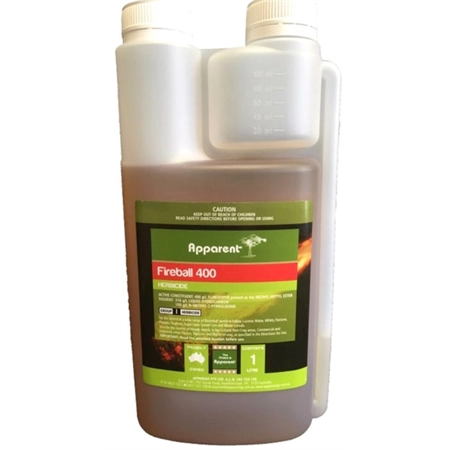
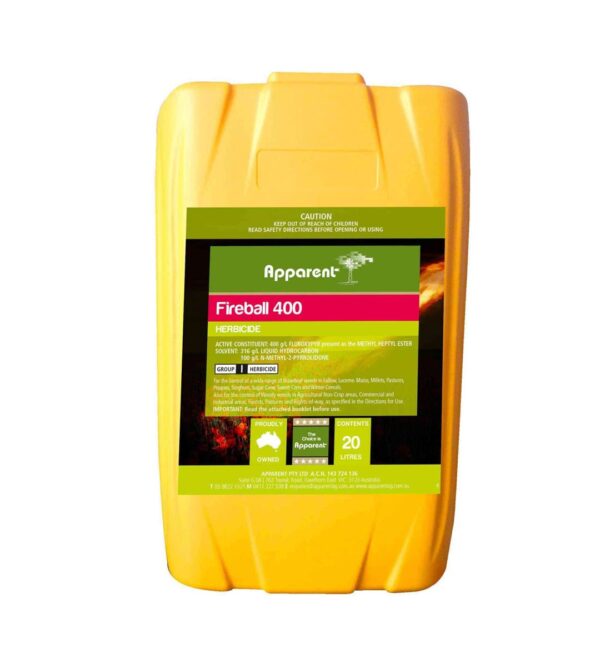
FIREBALL 400 Herbicide 1L – Powerful Weed Control for Large-Scale Applications

Loading...
Pro-Grade Quality
24hr Dispatch
FARM CHEMICALS · SKU: 038-066G

FIREBALL 400 Herbicide 1L – Powerful Weed Control for Large-Scale Applications

★★★★★4.7 (55 Google reviews)·In Stock — Ready to Ship

$99.00 Inc GST

FIREBALL 400 Herbicide is a 1 L pack of a 400 g/L fluroxypyr herbicide. The label lists broadleaf and woody weeds in pastures, crops, non-crop areas and rights-of-way. Lawn and home garden are not listed. It can damage ornamentals, vegetables, vines, pines and clovers.

In stock

Fast DispatchWithin 24hrs Australia-wide
Quality GuaranteedPro-grade formulations
1.45 kg32 × 12 × 24 cm
Need Advice?07 5537 4585
Active Ingredient400 g/L Fluroxypyr
SKU: 038-066G Category: Brand:

Related Products

Loading...

Product Description

FIREBALL 400 Herbicide is a 1 L pack of a 400 g/L fluroxypyr (as the methyl heptyl ester) herbicide (Group I, APVMA 81917). The label lists broadleaf weeds in fallow, lucerne, maize, millets, pastures, poppies, sorghum, sugar cane, sweet corn and winter cereals, and woody weeds in agricultural non-crop areas, commercial and industrial areas, forests, pastures and rights-of-way. Lawn or turf and home garden are not listed as uses.

It will damage plants you want to keep. The label lists susceptible crops and plants including clovers, cotton, fruit, hops, lupins, ornamentals, peas, pine trees, potatoes, soybeans, tomatoes, vegetables and vines, and says it can damage them during both growing and dormant periods. Legumes present at spraying will be severely damaged. Transitory damage can occur on stoloniferous grasses such as couch, kikuyu and carpet grass. Do not let spray drift onto susceptible crops, shade trees or pines.

When not to spray. Do not apply to stressed weeds that are not actively growing, if rain is likely within 1 hour, or when the temperature is above 30°C, there is no wind, or the wind is blowing towards susceptible crops.

Grazing. Do not graze treated pastures or failed crops, or cut for stock food, for 7 days after application. Poppies must not be sprayed later than 10 weeks before harvest.

Waterways. Do not contaminate streams, rivers or waterways with the chemical or used containers. Alongside waterways, treat only noxious weeds and poisonous plants.

How to use it. Rates depend on the weed and the situation, for example lantana 0.5 to 1.2 m high is 250 mL per 100 L of water. See the Application Rates tab, our herbicide mixing guide and the full label before mixing.

Before you buy. The label asks for cotton overalls buttoned to the neck and wrist, a washable hat, elbow-length PVC gloves, and a face shield or goggles. If poisoning occurs, contact a doctor or the Poisons Information Centre on 13 11 26. If swallowed, do not induce vomiting.

Delivery from $17, priced by weight and postcode at checkout.
Additional information

Weight1.45 kg
Dimensions32 × 12 × 24 cm
Size

1L

Safety Data Sheets (SDS)

Application Rates

Ground (Boom Sprayer):

Use at least 50 L/ha of water (100-400 L/ha for sugarcane).
Maintain proper nozzle height for even coverage.


Aerial Spraying:

Apply a minimum of 35 L/ha of water.
Avoid spraying in temperatures above 30°C or in no-wind or downwind conditions toward sensitive crops.


Woody Weeds:

Only spray when weeds are actively growing with at least 1 meter of new growth.
Special Methods


High Volume Applications:

Use a handgun or knapsack for small areas.
Spray to thoroughly cover leaves and stems.


Low Volume Applications:

Use a drench or gas-powered gun for targeted coverage.
Apply 50 mL to cover 4–5 m² of foliage.


Basal Bark and Cut Stump:

Basal Bark: Spray around the base of stems up to 30 cm high.
Cut Stump: Treat freshly cut stumps immediately.


Tips for use

Do not use on stressed plants: Avoid applying to plants affected by extreme cold, drought, waterlogging, poor nutrition, disease, or previous herbicide use.

Ensure thorough coverage: Apply to both leaves and stems until the liquid begins to run off.

Avoid rain: Do not spray if rain is expected within one hour.
Mixing Instructions


Mixing with Water:

Fill the spray tank halfway with water.
Add the required amount of Fireball 400.
Fill the tank with water and stir well.


Mixing with Diesel:

Fill the tank halfway with diesel.
Add Fireball 400 and then the remaining diesel.
Shake or stir to mix thoroughly.


Tank Mixtures:

Add powders or granules first.
Follow with flowable and water-soluble products, then Fireball 400.
Add oils and surfactants last.


Using Oils and Surfactants
Oils: Use Uptake Spraying Oil at 500 mL/100 L of spray mix.
Surfactants: Add 100 mL of a non-ionic surfactant (like Wetter 1000) per 100 L of spray mix when required.


Safety Instructions
Wear protective clothing, gloves, and goggles.
Wash hands and equipment after use.
Store safely and keep away from children.


First Aid
If swallowed: Do not induce vomiting; give a glass of water.

Emergency: Call a doctor or Poison Information Centre (Australia: 13 11 26).

Active Ingredients

400 g/L FLUROXYPYR present as the METHYL HEPTYL ESTER SOLVENT: 316 g/L LIQUID HYDROCARBON 100 g/L N-METHYL-2-PYRROLIDONE

Reviews

There are no reviews yet.

Be the first to review “FIREBALL 400 Herbicide 1L – Powerful Weed Control for Large-Scale Applications”

Your email address will not be published. Required fields are marked *

Frequently asked questions

Do I need a licence to buy or use these?

Most products here are unrestricted and can be bought and used by anyone following the label. A few are restricted chemical products that need a chemical user permit in some states - those are flagged on the product page. If in doubt, check the poison schedule on the label.

How do I work out the mixing rate?

The label gives a rate either per 100 L of water (a concentration) or per hectare or per 100 square metres (an area rate). For a knapsack, work out the area one tank will cover, then scale the per-area rate to that tank volume. Calibrate the sprayer before you start.

Why do the same chemicals come under different brand names?

Once an active ingredient comes off patent, several companies register their own version. A generic glyphosate 360 and a big-brand glyphosate 360 are the same active at the same strength - the difference is formulation quality, surfactant load and price.

EXCLUSIVE SAVINGS

Get 5% Off WHEN YOU JOIN OUR NEWSLETTER

Get deals sent straight to your inbox